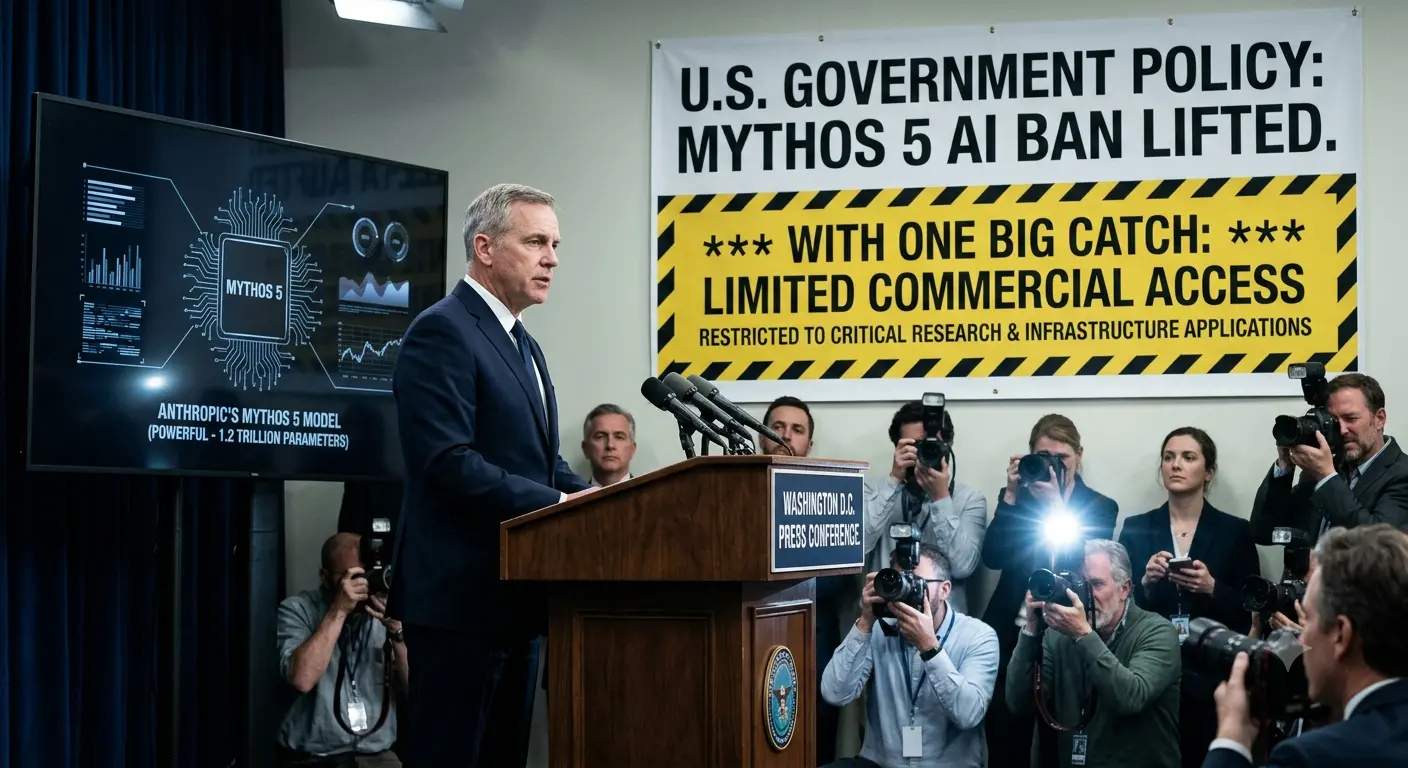
Two weeks ago, the US government did something unusual: it issued an export control directive blocking Anthropic from releasing its most advanced AI models, Claude Mythos 5 and Fable 5, citing national security concerns. On Friday, that standoff partially ended the Commerce Department cleared Anthropic to release Mythos 5 to more than 100 trusted US companies and government agencies. Fable 5 stays blocked for now.
What Actually Happened
US Commerce Secretary Howard Lutnick wrote directly to Anthropic confirming that adequate safeguards were now in place to allow specific “trusted partners” Fortune 500 companies and federal agencies among them to access Mythos 5 without needing an export license. The letter pointedly did not extend the same clearance to Fable 5, a weaker model that had briefly been the most powerful AI system publicly available, though people close to the talks say a similar release for that model may follow.
The original block, issued around June 12, reportedly traced back to security concerns raised after Amazon’s CEO flagged a jailbreak vulnerability in Anthropic’s models directly to the US Treasury Secretary. There were also separate reports that the White House grew uneasy about how widely Mythos access had spread, including concerns about a South Korean telecom provider’s access raising questions about indirect routes to China.
Why the Timing Is Notable
This resolution landed on the very same day OpenAI released its own new GPT-5.6 models also under a government-directed limited rollout to a small group of approved partners first, with broader availability planned for the following weeks. Two competing AI labs, both navigating a government-imposed gatekeeping process for their most capable models, on the same day. That’s not a coincidence so much as a sign of where AI policy is heading generally: rather than blocking frontier models outright, the emerging US approach looks more like a phased, government-approved rollout process applied to the entire industry, not just one company.
A Commerce Department spokesperson framed the speed of the resolution as evidence the system is working as intended, noting the two-week turnaround was meant to balance maintaining America’s competitive AI position with addressing security concerns.
Why This Matters Beyond the Headlines
For anyone working in or trying to enter the AI industry, this is a useful real-time look at a regulatory pattern that’s likely to keep recurring: powerful new AI models increasingly launch into a “trusted partner” tier before wider availability, with government sign-off as part of the process rather than an afterthought. If you’re aiming for a career in AI whether in model development, AI safety, or policy-adjacent technical roles this kind of staggered, government-coordinated release is becoming a normal part of how frontier AI ships, not an exception. It’s also a sign that “AI safety” and “AI policy” are increasingly real, hireable specializations within tech companies, not just academic concerns.
Frequently Asked Questions
The government issued an export control directive citing national security authorities, reportedly following concerns about a jailbreak vulnerability and the model’s access spreading to entities with potential indirect links to China.
No, the Commerce Department’s clearance applied only to Mythos 5. Fable 5 remains blocked, though reports suggest discussions toward releasing it are ongoing.
More than 100 US companies and government agencies have been granted access, including a number of Fortune 500 companies.
A similar pattern played out with OpenAI, which released its new GPT-5.6 models the same day under a government-coordinated limited rollout to trusted partners first, ahead of a planned wider release.
Sources: CNBC, Semafor, Reuters reporting via Ynetnews, and 9to5Mac, June 2026.