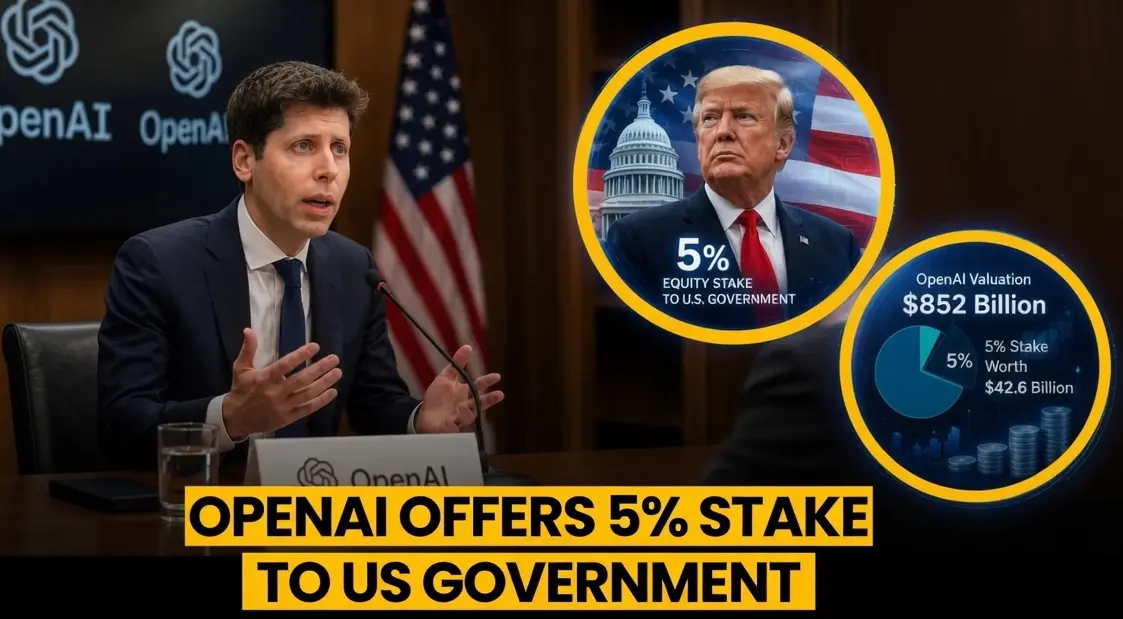
Sam Altman has proposed handing the US government a 5% stake in OpenAI, a slice worth roughly $42.6 billion based on the company’s current valuation and he’s reportedly asking other major AI labs, including Anthropic and Google, to do the same. The Financial Times broke the story this morning, with CNBC, Bloomberg, and Business Standard all confirming independently within hours. This isn’t a surprise announcement from OpenAI; Altman first floated the idea directly to President Trump in early 2025 and has been in active talks ever since. What changed is that it’s now public.
What OpenAI Is Actually Proposing
The proposal isn’t a conventional sale of equity OpenAI would donate a 5% stake to the federal government rather than sell it, meaning no direct cash changes hands from taxpayers. That equity would seed what OpenAI calls a “Public Wealth Fund” an idea the company first outlined in an April 2026 policy paper which would invest in AI companies and related industries, with returns distributed directly to American citizens, including those who currently own no stocks at all.
Under the broader framework being discussed, the proposal would also ask other leading US AI developers Anthropic, Google, and Meta to transfer comparable 5% stakes to the same government vehicle. Whether those companies would actually agree is explicitly uncertain; none of them have publicly confirmed any appetite for the arrangement.
At OpenAI’s current post-money valuation of $852 billion set during a record funding round in March a 5% stake works out to approximately $42.6 billion.
Why OpenAI Is Doing This Now
The FT’s framing “to defuse mounting political pressure in Washington” captures part of the story but misses some important context. This proposal has been in the works for over a year, not invented as a reaction to this week’s news. But the timing of going public with it is clearly not accidental:
- The US government just spent the last three weeks exercising export controls over Anthropic’s AI models, demonstrating that Washington now sees frontier AI as something it can and will regulate with direct orders and short timelines.
- Senator Bernie Sanders has a rival bill on the table the American AI Sovereign Wealth Fund Act that would impose a one-time 50% stock tax on OpenAI, Anthropic, and xAI, with the government receiving voting shares and board representation, not just a passive equity stake.
- The Trump administration has a demonstrated appetite for taking stakes in private tech companies: it took a 10% stake in Intel last August as part of an $8.9 billion investment, and Trump has since publicly said he should have asked for more.
Against that backdrop, offering 5% as a donation, with no government voting rights attached, looks strategically much cheaper than waiting for Sanders’ 50% tax bill to gain traction or for the government to unilaterally impose conditions the way it did with Anthropic’s export ban.
The Part That’s Most Significant for the AI Industry
If this deal goes through in any form, it sets a precedent that would fundamentally change the relationship between the US government and AI companies: Washington becomes a financial stakeholder in the technology it’s simultaneously trying to regulate. That creates an obvious tension a government that owns a piece of OpenAI has a financial interest in OpenAI doing well, which complicates its role as a neutral regulator.
It also fits the emerging pattern we’ve covered across the last two weeks: the Anthropic Mythos/Fable 5 export ban and its resolution, the government-coordinated rollout of GPT-5.6, and now a formal equity proposal. Taken together, these aren’t isolated incidents they’re the early shape of a new, government-involved AI governance regime that didn’t exist 18 months ago.
Why This Matters If You’re Building a Career in Tech
The relationship between AI companies and governments is being written right now, in real time, and it’s moving fast. Roles in AI policy, AI governance, legal and compliance at tech companies, and “trust and safety” functions are becoming genuinely important and genuinely hireable specializations, not add-ons that companies treat as optional. If you’re choosing a direction within tech, this is one of the clearest signals yet that the regulatory environment around AI is going to be a major part of the industry’s operating reality for the foreseeable future.
Frequently Asked Questions
Based on OpenAI’s March 2026 valuation of $852 billion, a 5% stake would be worth approximately $42.6 billion.
No, OpenAI’s proposal involves donating the equity to a government vehicle rather than selling it, so no direct taxpayer spending is involved.
OpenAI’s proposal reportedly calls for other major US AI labs to do the same, but none of those companies have confirmed they would agree, and no terms have been finalized.
Sanders’ American AI Sovereign Wealth Fund Act would impose a one-time 50% stock tax on major AI companies and give the government voting shares and board representation. OpenAI’s proposal is for a 5% passive equity stake with no voting rights attached, significantly less government control.
Sources: Financial Times (original report), CNBC, Bloomberg, and Business Standard, July 2, 2026. No final terms have been agreed and figures remain subject to change.