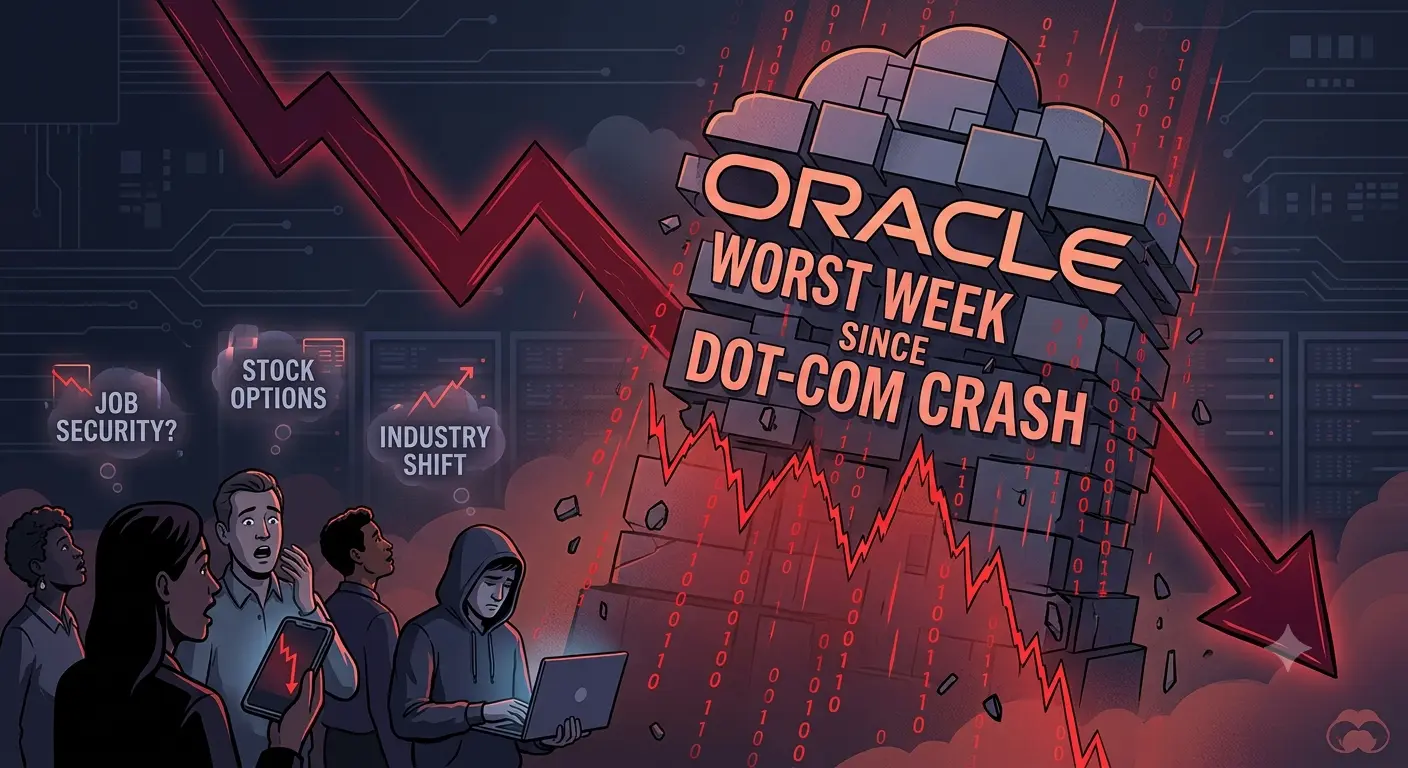
Oracle’s stock fell 19% this week its steepest weekly drop since August 2001, in the middle of the dot-com bust. This comes barely a week after Oracle’s own annual filing admitted that AI adoption had directly caused layoffs across its workforce. Two warning signs from the same company, in the same month, both pointing at the same question: is the AI spending boom actually sustainable, or is the bill finally coming due?
What’s Actually Going On
Oracle’s capital expenditure jumped 162% in the latest fiscal year, leaving the company with almost $24 billion in negative free cash flow and a debt pile that’s grown to $130 billion. To keep funding its AI infrastructure buildout primarily server farms built for OpenAI, which committed over $300 billion in spending to Oracle the company now plans to raise another $40 billion through debt and equity in fiscal 2027, on top of $43 billion in debt sales and $5 billion in new equity it already issued last year.
Wall Street’s concern isn’t whether AI demand is real analysts broadly agree it is, with 71% currently recommending the stock as a buy, the highest share in 15 years. The worry is narrower and more specific: can Oracle keep financing this scale of spending without the debt load itself becoming the problem.
The Bigger Picture This Fits Into
This isn’t an isolated wobble. Oracle’s stock has now lost roughly 55% of its value since peaking near $900 billion in market cap back in September, when enthusiasm about its AI customer pipeline was at its highest. The selloff this week also dragged down chip stocks more broadly South Korea’s SK Hynix fell over 8%, Samsung dropped around 5%, and the weakness spread into other AI-infrastructure-linked names.
Layer this on top of what we already know: Oracle’s own regulatory filing explicitly named AI adoption as a cause of its workforce reductions earlier this month. So the same company is simultaneously telling investors it needs tens of billions more in financing to keep building AI infrastructure, while telling regulators that AI already let it cut thousands of jobs. Those two facts sitting together are exactly why this week’s stock drop matters beyond just shareholders it’s a live test of whether the economics of the AI buildout actually work end to end.
Why This Matters If You’re Job Hunting in Tech
If you’re applying to roles at companies making large AI infrastructure bets not just Oracle, but any company pouring capital into data centers, compute, or AI tooling this is worth watching as a leading indicator, not just market noise. Heavy capital spending funded by debt creates real pressure to show returns quickly, and that pressure tends to land on headcount and budgets before it lands anywhere else. It doesn’t mean avoid these companies; many analysts remain genuinely bullish on Oracle’s long-term position. But going into an interview at any AI-infrastructure-heavy company right now, it’s a reasonable question to ask: how is the team you’re joining funded, and is it tied to a project with guaranteed multi-year revenue, or to more speculative AI bets still proving themselves out.
Frequently Asked Questions
Oracle shares fell 19% over the week due to mounting investor concern about the company’s growing debt load and whether its massive AI infrastructure investments will generate sufficient returns.
Not according to most analysts 71% currently recommend buying Oracle stock, and demand signals for its AI infrastructure remain strong. The concern is specifically about financing and debt risk, not lack of demand.
Oracle’s debt load has grown to roughly $130 billion, with plans to raise another $40 billion through debt and equity financing in fiscal 2027.
Indirectly Oracle’s fiscal 2026 filing explicitly named AI adoption as a cause of workforce reductions, while the company simultaneously increases AI infrastructure spending, highlighting the tension between cutting costs and funding AI growth at the same time.
Sources: CNBC, Business Insider, and FactSet analyst data, June 2026.